NES DATA

Author name: admin_nes

Modular Data Center
Colocation Solutions

The Advantages of Colocation Services for Growing Businesses

Every growing business faces a critical decision regarding its IT infrastructure. As operations expand, so do the demands for reliability, scalability, and security. While some companies consider in-house solutions, many turn to colocation services for a cost-effective and efficient alternative. This strategy allows businesses to house their servers in a third-party facility. It helps to access enterprise-level resources without the burden of maintaining an in-house data center. Cost Efficiency Without Compromise Investing the money to set up and maintain an on-premises data center represents a significant capital outlay. The company must invest in high-quality equipment, cooling systems, power backups, and security systems. Colocation services will eliminate this cost by providing a shared infrastructure at a much lower cost. The company does not have to spend money on real estate and IT management, and can continue to invest in the core business operations. Data center colocation facilities offer predictability in costs with monthly pricing, allowing businesses to budget easily. The monthly pricing model eliminates the risk of unexpected costs associated with higher-than-expected power consumption due to surges, equipment failures, and emergency repairs. Purchasing colocation space is much easier on capital planning and cash flow. Scalability for Dynamic Growth Increasing IT capacity in-house typically involves securing more space, investing in expensive equipment, and dealing with considerable downtime. Data center colocation takes the complication out of this process and provides flexible, scalable solutions to help meet growing business demands. A colocation provider can provide rack space, more bandwidth, and the required security layers without requiring the type of investment in resources associated with an in-house solution. Data center colocation facilities also offer highly optimized connectivity with a variety of network providers that allow optimum data flows. This type of access increases data flows by eliminating latency and lead time, which is especially useful during rapid growth. As either your customer or operational base begins scaling, a colocation provider can drop it in without expensive downtime and resource limitations on your network edge. Enhanced Security and Compliance Cyber threats continue to evolve, making security a top priority for businesses. Colocation services offer multiple layers of protection, including 24/7 surveillance, biometric access control, fire suppression systems, and redundant power sources. These features safeguard sensitive data while ensuring uninterrupted operations. Compliance with industry regulations is another crucial advantage. Many businesses must adhere to strict guidelines such as GDPR, HIPAA, or ISO standards. Data center colocation providers maintain compliance-ready environments, helping companies meet legal requirements without extensive in-house audits or upgrades. Reliability and Business Continuity Downtime can severely impact productivity and revenue. Unlike in-house setups, colocation services guarantee high uptime with redundant power sources, failover mechanisms, and advanced cooling solutions. These facilities operate on N+1 redundancy, meaning that even if one component fails, backups ensure continuous operation. In addition, data center colocation providers offer disaster recovery solutions, allowing businesses to maintain operational continuity in case of natural disasters or cyberattacks. By leveraging geographically diverse facilities, companies can create a fail-safe system that minimizes disruptions. Access to Expert IT Support Managing an in-house IT team requires hiring specialists, investing in training, and maintaining 24/7 availability. Colocation services provide access to expert technicians who monitor and troubleshoot infrastructure issues around the clock. This support minimizes downtime, improves efficiency, and ensures optimal server performance. Most data center colocation providers offer managed services, including hardware maintenance, software updates, and network optimization. This level of expertise allows businesses to focus on growth strategies while leaving infrastructure management to professionals. Eco-Friendly and Sustainable Operations Sustainability has become a business imperative, and colocation facilities are designed with energy efficiency in mind. Many data center colocation providers use renewable energy sources, advanced cooling technologies, and energy-efficient hardware to reduce carbon footprints. This helps businesses lower their environmental impact and aligns with corporate social responsibility goals. Conclusion For businesses seeking reliability, scalability, and cost efficiency, colocation services offer a compelling solution. By leveraging shared infrastructure, enhanced security, and expert support, companies can focus on innovation and growth rather than IT management. As the demand for flexible and resilient IT solutions continues to rise, data center colocation remains a strategic choice for businesses aiming to scale efficiently and securely. FAQs: 1. What are colocation services in simple terms? Colocation services allow businesses to place their servers in a third-party data center that provides power, cooling, security, and connectivity. This gives companies enterprise-grade infrastructure without the cost of building and managing their own facility. 2. Is data center colocation suitable for small and growing businesses? Yes. Colocation is ideal for growing businesses because it offers flexible scaling, strong security, expert support, and high uptime. Companies can expand their IT capacity quickly without downtime or major upfront investment. 3. Why are NES DATA colocation services ideal for growing businesses? NES DATA provides scalable colocation services that allow businesses to start with minimal rack space and expand without downtime. With predictable pricing, high uptime infrastructure, and managed support, companies can grow their digital operations without heavy capital investment. 4. How do colocation services improve reliability compared to on-premise setups? Colocation facilities use redundant power, backup generators, advanced cooling, and 24/7 monitoring. This ensures higher uptime, faster disaster recovery, and continuous operations compared to most in-house server environments. 5. How does NES DATA reduce infrastructure costs for startups and mid-sized companies? By eliminating the need to build and maintain an in-house data center, NES DATA offers shared, enterprise-grade infrastructure with monthly operational costs. This improves cash flow, simplifies budgeting, and allows businesses to invest more in innovation and core growth.

Server Racks
Data Centers

All About Edge Data Centers and Why India Needs Them

As the edges of the digital world are stretching out, there is increased demand for the infrastructure that will support it. Edge data centers are necessary in this expanding digital world to bear the load of storage, processing, and responding in real-time. If you look at the example of a retail chain, it uses edge data centers at individual store locations to process customer purchases, manage inventory in real time, and provide personalized recommendations without relying on a central data center for every interaction. Hence, as an individual or an enterprise in this digitized world, let’s learn more about what edge data centers are. What Are Edge Data Centers? Edge data centers are small, localized facilities that process and store data closer to the end users or devices they serve. Unlike traditional, centralized data centers, which are often located far away, edge data centers are positioned near the “edge” of the network to reduce latency and improve efficiency. To understand edge data centers, we first need to understand what edge and edge computing mean in the data industry. Edge represents the extreme points of a network, end users, and devices that are connected to that network. Edge computing is a technology that processes data near the end user and sends only necessary and summarized data to the central system. In today’s world, 55% of the world’s population lives in urban areas. According to UN reports, by 2050, we will see 68% of the world’s population is expected to live in urban areas. In a smart city, edge data centers play a pivotal role by processing massive amounts of data generated by traffic cameras, sensors, and public Wi-Fi locally. Similarly, due to the rollout of the 5G network, increased use of IoT devices, and smart technology, the data center architecture needs edge data centers to process and analyze large amounts of data at the regional level to reduce latency. Edge data centers are located near data sources and reduce the data load of central and hyperscale data centers. Why India Needs Edge Data Centers India needs edge data centers to significantly reduce latency for users by processing data closer to where it is generated, improving user experience for applications like IoT, 5G, and real-time analytics, especially in geographically diverse regions, while also supporting the country’s rapid digital transformation and growing demand for cloud services; essentially bringing data processing closer to the end-user, enhancing performance and accessibility across India. Let’s examine the key reasons why India needs edge data centers. Key reasons why India needs edge data centers: Lower Latency: By positioning data centers nearer to users in Tier 2 and Tier 3 cities, edge computing reduces data travel time. This is essential for applications that require quick response times, such as live streaming, online gaming, and autonomous vehicles. Increase in IoT Adoption: With the rise of IoT devices generating large amounts of data at the network edge, that is, at the end of a network like local areas. Edge data centers can process this data locally without sending it to a distant central data center. Enhanced User Experience: In India’s rapidly growing digital landscape, every business needs an effective system to minimize latency and maintain a positive Net Promoter Score (NPS). Thanks to their capability to reduce latency, edge data centers can significantly improve user experience across various sectors, including healthcare, IT, and retail. Digital Inclusion: Bringing edge data centers to rural areas can make a difference in digital access for underserved communities. This means more people can connect online and benefit from the opportunities that come with it. By improving access, we’re not just closing the digital gap but giving everyone a chance to thrive in our increasingly digital world! Upgraded 5G Network Support: 5G and edge data centers work together to deliver faster speeds and lower delays. Edge data centers are vital for maximizing the potential of this groundbreaking technology. At the same time, 5G connects more devices and generates massive data; edge data centers process that data close to where it’s created. They can effectively manage high-speed data and ensure fast and seamless operations. Compliance with Data Localization: Edge data centers prioritize both real-time data processing and secure storage. Every firm must comply with data localization requirements, and edge data centers are instrumental in doing so. By storing sensitive data within the country, businesses ensure compliance with laws that demand local data storage. This strategy meets regulatory standards and adds security to sensitive information. Conclusion: The edge data center industry will continue expanding in the coming years. Edge data centers have a vital role in meeting the increasing demand for low-latency access to applications and services driven by cloud services, modern technologies, big data, and IoT. While they are local and smaller than the typical data center, they bring computing resources closer to the users they serve and enhance performance. As India marches towards a digital-first future, edge data centers will be pivotal in creating a connected, efficient, and inclusive society. FAQs: 1. Why should enterprises choose NES DATA for distributed digital infrastructure? NES DATA offers strategically located, scalable colocation environments that bring compute closer to users. This improves application speed, ensures regulatory compliance, and enables enterprises to expand digital services without investing in multiple self-built facilities. 2. Where are edge data centers typically located in India? Edge data centers are usually deployed in metro clusters, telecom exchange points, industrial corridors, and Tier 2 and Tier 3 cities to bring compute closer to users and support regional digital services with faster response times. 3. How do edge data centers support data localization and digital sovereignty? Edge facilities store and process data within national or regional boundaries, helping organizations meet data localization regulations, enhance security, and maintain control over sensitive information while still delivering low-latency digital services. 4. How can NES DATA support edge data center deployments in India? NES DATA provides strategically located, scalable colocation facilities that act as regional edge hubs. This allows enterprises to deploy

Data Center
Data Centers

The Hidden Costs of On-Premise Data Centers: What Most Businesses Overlook

When businesses consider setting up an on-premise data center, they often focus on the immediate benefits, such as control, security and customization. However, many overlook the hidden costs that come with managing an in-house data center. From 24/7 staffing to capital investments and scalability challenges, the true cost of an on-premise setup can be much higher than anticipated. In this blog, we’ll break down the real expenses of running an on-premise data center and explore why colocation services can be a smarter, more cost-effective alternative. The High Cost of 24/7 Manpower Running an on-premise data center requires round-the-clock staffing, typically in three shifts, to ensure uptime, security, and maintenance. This means: Salaries for IT staff, security personnel, and facility managers Training and retention costs (high turnover in IT ops is common) Overtime and emergency call-outs Unlike colocation services, where the provider handles staffing, an in-house setup means ongoing labor expenses that add up quickly. Operational Costs and Overheads Setting up an on-premise data center requires massive upfront investments, including: Cooling systems, power backups and physical security Real estate and construction costs Additionally, technology depreciates rapidly. In 3-5 years, your equipment may become obsolete, forcing costly upgrades. With colocation, you can avoid these capital expenses. As a third party provides the infrastructure, you only pay for the space and power you use. Compliance and Liability Managing an on-premise data center means taking full responsibility for: Regulatory compliance (ISO, SOC, GDPR, etc.), achieving certifications is expensive Risk of downtime & data loss (your team bears the liability) In contrast, a colocation services provider comes with enterprise-grade infrastructure, built-in redundancy, and compliance-ready facilities, reducing your operational risks. Scalability Challenges Scaling an on-premise data center is slow and expensive. Need more capacity? You’ll have to: Expand physical space (construction and permits) Reconfigure power and cooling With colocation, scaling is seamless. You can increase or decrease resources on demand without incurring huge capital outlays. Future-Proofing and Expertise Technology evolves fast. Maintaining an in-house data center means: Constant upgrades to keep up with advancements Hiring specialists for security, networking, and cloud integration Managing unforeseen costs Colocation services providers like NES DATA eliminate these headaches with future-ready infrastructure, 24/7 expert monitoring, and flexible solutions that grow with your business. Why NES DATA is the Smarter Choice for Colocation At NES DATA, we understand the hidden costs of on-premise data centers, which is why our colocation services are designed to cut your expenses while delivering enterprise-grade reliability. No subcontracting: Our in-house team handles everything, ensuring quality and accountability. Cost-efficient builds: Our data centers are optimized for performance and affordability. Scalable, secure, and compliant: Focus on your business while we manage the infrastructure. Final Thoughts While on-premise data centers offer control, the hidden costs, manpower, capital, compliance and scalability make them a financial burden for many businesses. Colocation with NES provides a cost-effective, flexible, and hassle-free alternative, allowing you to scale efficiently without the heavy investments. FAQs: 1. What is the real cost of running an on-premise data center? The real cost includes power, cooling, 24/7 staffing, maintenance, upgrades, compliance, and risks associated with downtime. These operational and capital expenses often exceed initial estimates, straining long-term IT budgets for growing businesses. 2. How does NES DATA help reduce the hidden costs of on-premise data centers? NES DATA delivers cost-efficient colocation with in-house operations, eliminating staffing, infrastructure, and compliance burdens while providing scalable, enterprise-grade environments. 3. Why is compliance more expensive in an on-premise setup? Businesses must independently design, implement, audit, and maintain certification-ready infrastructure, which requires specialised expertise, continuous monitoring, and frequent investments. 4. Why is future-proofing difficult with an on-premise data center? Rapid technology evolution demands frequent upgrades in power density, cooling, networking, and security, making it costly and complex to keep infrastructure ready for AI and high-performance workloads. 5. Is NES DATA colocation suitable for high-growth and hybrid IT strategies? Yes, NES DATA supports hybrid and high-growth environments with scalable capacity, high availability, and interconnection-ready infrastructure, enabling seamless expansion without large upfront investments.

News

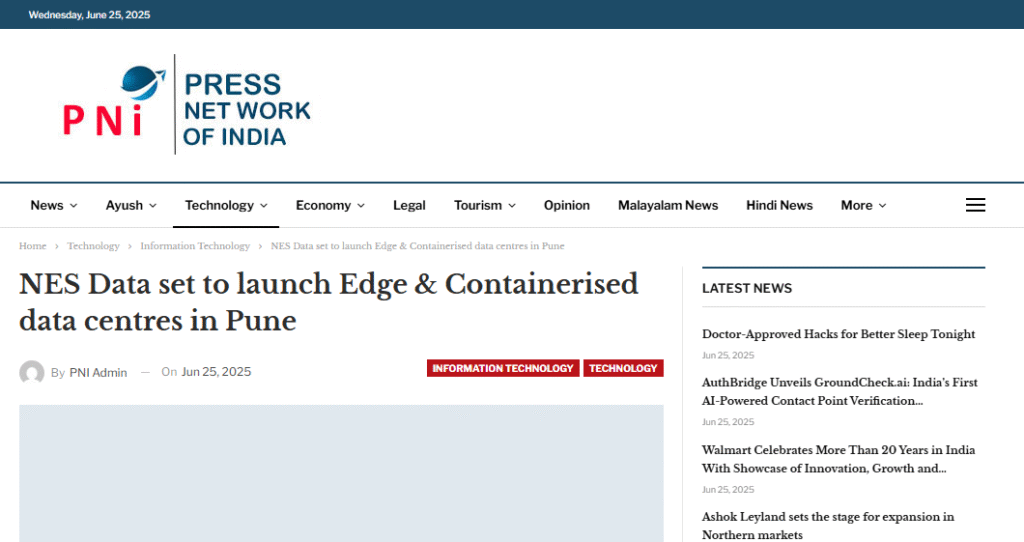
NES Data set to launch Edge & Containerised data centres in Pune

NES Data Pvt Ltd is set to launch a next-gen Edge and containerised data center in Pune. These modular and sustainable solutions are designed to meet the growing demands of AI, real-time applications and remote deployments, especially in Tier II and underserved regions across India. The centers integrate compute, storage, cooling, and battery systems with zero-touch operations and hybrid cloud integration, enabling lower latency and reduced costs. For more

News

NES Data Plans New Data Centre Units in Pune

In Pune, NES Data Pvt Ltd to launch a cutting-edge edge and containerized data center that is optimized for AI, real-time applications and remote deployments. These eco-friendly, modular centers provide plug and play scalability, minimal latency and quick deployment. NES seeks to provide decentralized infrastructure to Tier II and rural cities in response to growing data demand and expensive metro expenses, paving the way for a more sustainable and equitable digital future for India. For more

Data Center
Data Centers

Colocation vs On-Premise Data Center: What’s Driving Infrastructure Strategy in 2025?

India’s accelerated transition into a digital-first economy has fundamentally reshaped how organizations think about infrastructure. As government rules get stricter and more industries start using advanced digital tech, the colocation vs on-premise data center debate is no longer just about cost—it’s about control, compliance, and continuity. Policy Pressure and the Rise of the Colocation Data Center The Indian government’s data localization initiatives, such as the Digital Personal Data Protection Act, 2023, and MeitY’s Draft Data Centre Policy, have made it clear: critical and sensitive data must reside within national borders. Even though the rules don’t say companies must build or own their own data centers (on-premise ownership), they do require that data is stored in places that meet certain conditions, that is, to host data in compliant, geographically proximate, and certified environments. This has triggered a surge in colocation adoption, particularly in Tier III and IV data centers. They deliver highly available, compliant, and scalable infrastructure. These facilities offer localized data residency to meet national data protection laws, are backed by enterprise-grade SLAs, and are certified under standards like ISO 27001, PCI-DSS, and HIPAA, depending on industry requirements. Their redundant power, cooling, and network systems, along with strong physical and logical security layers, make them well-suited for hosting regulated workloads. In sectors such as financial services, healthcare, and government-aligned operations, disaster recovery (DR) compliance has become critical. Regulatory bodies like the RBI and SEBI expect organizations to maintain DR sites in geog  raphically separate locations, conduct regular failover drills, and ensure minimal disruption during outages. Colocation data center providers support these requirements with low-latency connectivity between primary and DR environments, pre-designed resilience zones, and the ability to rapidly scale recovery infrastructure, all while staying aligned with documented regulatory thresholds. On-Premises Data Center: Pros and Cons On-premises data center offers full control over infrastructure, which is a significant advantage for organizations with strict compliance, customization, or security requirements. Enterprises can tailor everything, from power and cooling systems to firewall configurations and network segmentation, based on internal IT policies. This model often appeals to companies with legacy applications, proprietary workloads, or regulatory standards that mandate direct ownership and isolation of data and hardware. However, the drawbacks are increasingly difficult to ignore. The development of on-premise data centers demands high upfront capital investment (CAPEX), ongoing maintenance, skilled manpower, and long build cycles. Scaling is rigid and often over-provisioned “just in case,” leading to resource underutilization. Additionally, meeting evolving compliance standards (like updated ISO, PCI, or DR requirements) can be complex and cost-prohibitive without dedicated teams. In contrast, colocation or hybrid models offer greater agility, redundancy, and faster time-to-market, especially in today’s compliance-driven, high-availability business landscape. Not Just Policy Every Sector is in the Debate Beyond policy-driven sectors, the colocation vs on-premise data center question is playing out across the digital ecosystem: Manufacturing & Industry 4.0: Colocation supports this with low-latency interconnects, while on-premise data centers handle time-critical workloads. Media & Streaming: Media and streaming platforms need fast, global delivery. Colocation helps by placing content servers near users, improving speed and saving costs. Healthcare & Life Sciences: Needs secure handling of health records & research data. Hybrid deployments enable compliance and clinical speed. E-commerce & Retail: Experiences seasonal traffic spikes—colocation enables scalable footprint without infrastructure lock-in. Agritech & Precision Farming: Uses IoT, drones, and AI analytics. A mix of rural edge capture + metro data crunching is ideal—colocation bridges that gap. Key Deciding Areas Organizations evaluating Colocation vs On-Premise data center issues should weigh these strategic criteria: Capital Efficiency: On-premise requires a large upfront investment (CAPEX), while colocation shifts costs to operational expense (OPEX). Scalability: Colocation data center enables elastic infrastructure without overbuilding. Resilience: Redundant power, cooling, and security are built-in with leading colocation providers. Regulatory Readiness: Colocation supports evolving compliance through certified environments. Speed to Market: Colocation deployments go live in weeks; on-premise data centers build may take 12–18 months. Final Thought Whether in fintech or farm tech, the digital core of every organization needs to be secure, scalable, and compliant. In this environment, colocation is no longer just an operational choice, it’s a strategic enabler. It provides the agility of the cloud, the control of on-prem, and the resilience enterprises need to thrive in a policy-aware, performance-hungry digital economy. FAQs: 1. Why is colocation gaining importance in India’s data center strategy in 2025? Data localization laws, disaster-recovery mandates, and faster digital adoption are pushing enterprises toward compliant, scalable, and geographically distributed infrastructure that colocation facilities can deliver without long construction timelines. 2. How does data localization impact colocation vs on-premise decisions? Regulations require data to stay within national borders in certified environments. Colocation provides compliant, in-country infrastructure without forcing enterprises to build and manage their own data centers. 3. Why are regulated industries moving to colocation data centers? Certified facilities with ISO, PCI-DSS, HIPAA, and high-availability SLAs help meet compliance, security, and uptime requirements without the operational burden of maintaining these standards internally. 4. How does colocation reduce time-to-market for digital businesses? Colocation environments are deployment-ready with power, cooling, connectivity, and security in place, enabling go-live timelines in weeks instead of the 12–18 months required for on-premise builds. 5. How does scalability differ between colocation and on-premise data centers? Colocation allows rapid capacity expansion with additional racks, power, or interconnects. On-premise scaling requires construction, procurement cycles, and infrastructure redesign, making it slow and capital-intensive.

Green Data Centers
Data Centers

How Maharashtra Is Leading the Charge in Green Data Centers

As the demand for sustainable digital infrastructure intensifies, green data centers in Maharashtra are fast becoming the blueprint for India’s future. With an ambitious policy framework, massive investments, and strong political will, Maharashtra is not only supporting India’s data-driven economy but also keeping a firm eye on environmental responsibility. Maharashtra: India’s Digital Powerhouse Maharashtra has emerged as the digital nerve center of India, home to nearly 60% of the nation’s data centers, with Mumbai alone accounting for 54.9% of the national capacity. From a current capacity of 500 MW, the state is on track to reach 800 MW by 2028, reinforcing its status as the country’s digital backbone. This dominance isn’t just about numbers; it’s about readiness. With its robust infrastructure and a deep talent pool, Maharashtra has created a reliable foundation for green data center development, appealing to both global tech investors and hyperscale operators. A Vision Backed by Policy Maharashtra became the first Indian state to roll out a dedicated policy for Green Integrated Data Centre Parks, outlining a plan to develop 1.5 GW of IT capacity across multiple sustainable campuses. The state’s updated IT/ITES Policy (2023) offers added incentives, especially for land acquisition and infrastructure development, making it easier for operators to build and scale green facilities. A testament to this policy’s impact, the state secured $20 billion in signed MoUs at the World Economic Forum in Davos, signaling confidence from global tech leaders. These parks aren’t just green in branding—they’re designed to integrate sustainable practices, from efficient cooling systems to renewable energy use, setting new benchmarks for green data centers in Maharashtra. Maharashtra’s Digital Ambition The government has set its sights on becoming a $1 trillion economy within the next 4–5 years, with the potential to grow to $1.5 trillion if planned strategically. As the state fosters a pro-tech, pro-investment environment, its leadership also envisions Maharashtra as the future hub for artificial intelligence. To meet the growing power demands of data infrastructure, the state plans to boost its energy capacity from 45,000 GW to 75,000 GW by 2030 and 52% of which will come from green and non-conventional sources, reinforcing its ESG-driven vision. Economic and Environmental Impact Maharashtra’s push for green data centers promises a dual benefit: economic growth and environmental progress. The initiative is expected to generate over 500 high-skilled jobs and 3,000 indirect opportunities, alongside contributing to India’s carbon neutrality goals for 2070. It also ensures direct and indirect tax revenues while encouraging global players to establish a long-term presence in India’s digital landscape. With a 40% market share, the state remains the top choice for data center operators and service providers. Building Sustainable Data Centers: What’s Being Done? Maharashtra has introduced several policy measures to support its green data center ambition, including developing Green Integrated Data Centre Parks and amendments to its IT/ITES Policy (2023). These focus on eco-friendly building practices, energy-efficient infrastructure and prioritizing renewable energy sources for power consumption. The parks are also designed to meet global environmental standards, aiming to reduce emissions and promote sustainability from the ground up. Managing the Energy Shift: How Will Maharashtra Power Its Digital Growth? As the state moves from a current power capacity of 45,000 GW to a projected 75,000 GW by 2030, it aims to ensure that 52% comes from green and non-conventional sources. This includes investments in solar, wind, hydroelectric projects, grid upgrades and storage solutions. Maharashtra’s long-term plan is to decouple data center expansion from carbon-intensive energy consumption. Facing Forward: What Challenges Lie Ahead? While the vision is bold, the road ahead comes with challenges. Scaling renewable energy capacity at pace, ensuring grid stability and maintaining affordability for investors are key hurdles. Building skilled talent for green infrastructure management and navigating environmental clearances may also pose operational delays. However, the government’s proactive policy framework and significant investment interest indicate strong momentum. NES Data: Aligning Infrastructure with Impact NES Data, a next-generation colocation provider in Pune, is at the heart of this transformation. With scalable, ESG-aligned infrastructure tailored for large-scale cloud service providers and enterprises, NES Data represents Maharashtra’s new data center era. Located strategically in the heart of Maharashtra’s IT Hub, NES Data offers best-in-class connectivity, energy efficiency and future-ready power capacity, all in sync with the state’s green agenda. Conclusion Maharashtra’s roadmap for green data centers isn’t just about meeting digital demand—it’s about doing it responsibly. Through policy, partnerships and vision, the state is creating a future where infrastructure and sustainability go hand in hand. For global enterprises looking to expand in India, green data centers in Maharashtra offer a compelling proposition: world-class capabilities with a conscience. FAQs: 1. What is a green data center and how is it different from a traditional facility? A green data center is a facility designed to minimize environmental impact through renewable energy use, efficient cooling, optimized power consumption, and sustainable construction. It is important because data demand is rising while enterprises are under pressure to meet ESG and net-zero goals. 2. How much data center capacity does Maharashtra currently have? Maharashtra has about 500 MW of operational capacity and is projected to reach nearly 800 MW by 2028, making it India’s largest data center market. 3. Why is Maharashtra leading India’s green data center growth? Maharashtra leads due to its existing digital infrastructure, strong connectivity, hyperscale demand, progressive data center policies, and large renewable energy expansion plans. These factors enable faster deployment of sustainable, high-capacity facilities compared to other Indian states. 4. Which government policies are driving green data centers in Maharashtra? The Green Integrated Data Centre Parks initiative and the IT/ITES Policy 2023 provide incentives for land acquisition, infrastructure development, and sustainable design. These policies reduce entry barriers and accelerate investment in environmentally responsible digital infrastructure. 5. Why do global hyperscalers prefer Maharashtra for sustainable data center investments? Hyperscalers choose Maharashtra for its dense fiber connectivity, access to subsea cable landing stations, renewable energy roadmap, large land parcels, and proximity to India’s biggest enterprise and cloud consumption markets. References: Developing Telecoms

Data Center in Pune
Data Centers

Why Location Matters: Pune as India’s Emerging Data Center Hub

A city or region becomes a data center hub when it offers the right mix of infrastructure, talent, and sustainability. With its strong foundations, skilled workforce, and access to renewable energy, Pune is emerging as a prime destination for companies setting up a data center in Pune. This strategic blend makes the city a compelling choice for performance, scalability, and sustainability. This shift toward Pune isn’t just about location; it’s about Pune’s ability to offer a future-ready ecosystem where data centers can flourish. As India’s digital needs expand, Pune’s mix of innovation and natural advantages positions it as a rising star in India’s data center boom. It blends its reputation as an educational and IT powerhouse with the growing demands of the digital age, offering a future-ready ecosystem where data centers can flourish. This strategic mix positions Pune as a compelling choice for companies striving for performance, scalability and sustainability in an ever-changing technology scene. This shift toward Pune isn’t just about location—it’s about Pune’s ability to offer a future-ready ecosystem where data centers can flourish. As India’s digital needs expand, Pune’s mix of innovation and natural advantages positions it as a rising star in India’s data center boom. Thriving IT Ecosystem and Skilled Workforce India is establishing itself as a significant presence in the digital economy. As part of India’s global capability centers, Pune has developed a wealth of IT workers because of its well-established IT ecosystem and esteemed educational institutions. The city accounts for approximately 15% of India’s tech workforce, reflecting its substantial role in the sector. Furthermore, the employability rate in Pune stands at an impressive 78.3%, underscoring the city’s capacity to meet the workforce demands of the IT industry. This thriving environment fosters innovation and provides data centers with access to skilled personnel essential for operations and growth, giving you confidence that Pune can meet your workforce needs. Proximity to Mumbai: Enhanced Connectivity Located approximately 150 kilometers from Mumbai, Pune benefits from close proximity to one of India’s primary financial centers and a central internet exchange point. This nearness ensures low-latency connectivity and robust network infrastructure, which is crucial for data-intensive operations. Pune is home to several prominent IT hubs that host a wide range of IT and tech companies. The key areas are Hinjewadi, Magarpatta Cybercity, Kharadi, Baner–Balewadi, Pimpri-Chinchwad (Talwade IT Park), Yerwada & Viman Nagar. Favorable Climate and Geographical Stability Pune’s inland setting boasts a pleasantly temperate climate, shielding it from the tumult of natural disasters that often plague coastal cities. This enviable stability fosters a more efficient environment for data centers, minimizing cooling needs while maximizing operational reliability. The distinctive geographical advantages of Pune evoke a strong sense of security, making it an ideal location for technological hubs and digital infrastructure. Access to Renewable Energy Sources The region around Pune is witnessing growth in renewable energy projects, including solar and wind farms. For instance, Maharashtra’s focus on expanding its renewable energy capacity aligns with the sustainability goals of modern data centers. Proximity to these green energy sources enables data centers to reduce their carbon footprint and operational costs by utilizing cleaner power. Government Initiatives and Market Growth The Indian government’s push for digitalization and data localization, coupled with favorable policies, has attracted significant investments in the data center sector. The need for data storage due to the government’s Digital India and data localization policies, rising data consumption (~25GB/user/month), and the rollout of 5G, which is anticipated to facilitate the adoption of data-intensive technologies. Reports indicate that India’s data center market is projected to reach substantial valuations in the coming years, reflecting the country’s growing demand for data storage and processing capabilities. NES Data: Shaping the Future of Colocation in Pune Amid Pune’s growing appeal as a digital infrastructure hub, NES Data stands as a key enabler of future-ready colocation. Located in the heart of the city’s IT belt, Hinjewadi, NES Data’s Tier III carrier-neutral facility combines performance, resilience and sustainability—qualities that resonate with the very reasons Pune is gaining prominence. Its modular and scalable architecture allows businesses to adapt to shifting workloads without disruptions. At the same time, AI-optimized infrastructure and liquid-cooled systems make it ideal for compute-intensive operations like AI and HPC. Backed by an N+1 redundancy model, NES ensures uninterrupted uptime and dependable performance for mission-critical workloads. The facility is designed to support low-latency, high-density environments, with robust ISP connectivity and a 6-layer physical security system safeguarding data at every step. More than just a colocation provider, NES Data is also committed to ESG goals, implementing green building practices, efficient power usage (PUE 1.4) and water-saving cooling technologies. In a city that promises scalability and sustainability, NES Data reflects Pune’s digital potential—reliable, efficient and ready for tomorrow. Conclusion Pune’s strategic advantages—ranging from its skilled workforce and connectivity to favorable climate and access to renewable energy—position it as a compelling choice for data center operations. The estimated size of India’s data centers is 7-8 million square feet. By 2030, it is most likely to grow to 30 million square feet. In the western region of India, Pune is one of the top cities with growing data centers. As India’s digital economy continues to expand, Pune is set to play a pivotal role in supporting the nation’s data infrastructure needs and become India’s emerging data center hub. Pune offers a compelling foundation for businesses looking to scale securely and sustainably. With players like NES Data driving this transformation through future-ready, ESG-aligned colocation solutions, Pune isn’t just keeping pace—it’s helping shape the future of India’s digital economy. For organizations seeking a strategic location that combines operational excellence with environmental responsibility, Pune and NES Data offer a clear path forward. FAQs: 1. Why is Pune considered an emerging data center hub in India? Pune offers low disaster risk, proximity to Mumbai’s cable landing stations, a large IT talent pool, scalable land availability and access to renewable power. These factors enable low-latency, cost-efficient and future-ready data center deployments. 2. What makes Pune better than Mumbai

Colocation Partner
Colocation Solutions

Choosing the Right Colocation Partner: What Makes NES Data Stand Out

As businesses scale and digital demands intensify, selecting the right colocation partner is more critical than ever. Today, organizations need more than just rack space they need resilient infrastructure, top-tier security and sustainable operations. NES DATA is not just redefining colocation but also future-proofing it with a commitment to high-performance infrastructure, operational excellence and a forward-thinking approach that ensures you’re prepared for the challenges of tomorrow. Scalability and Customization: The Foundation of Future-Ready Colocation In today’s rapidly evolving technological landscape, one of the most daunting challenges businesses face is the ability to foresee and adapt to their future IT needs. As companies strive to grow and innovate, the demand for flexible, scalable solutions becomes paramount. A colocation strategy that emphasizes both scalability and customization allows organizations to seamlessly expand their infrastructure, ensuring they remain agile and prepared for whatever the future may hold. NES Data addresses this with modular and scalable design, allowing companies to expand seamlessly without operational disruptions. Whether businesses require shared rack space, half/full racks, or custom-built infrastructure, NES Data provides tailored colocation solutions to meet evolving workloads. Unlike traditional colocation providers, NES Data doesn’t just offer off-the-shelf solutions. We ensure custom-built rack infrastructure and on-site managed services, empowering businesses with flexible configurations. This adaptability puts you in control, especially for enterprises handling high-density AI workloads and HPC computing, where one-size-fits-all solutions just won’t cut it. Reliability Through Redundancy: N+1 Model for Uninterrupted Performance Downtime is not an option in today’s digital landscape. NES Data’s N+1 redundancy model is not just a feature but a promise of uninterrupted operations, even in the event of component failure. With redundant power, cooling and network systems, businesses can rely on 99.982% uptime to support their mission-critical workloads, giving you the confidence to focus on your business. Furthermore, NES Data’s carrier-neutral Tier III data center in Pune’s thriving IT hub offers robust connectivity through multiple ISPs, ensuring low-latency, high-performance networking. This strategic location provides seamless access to India’s fast-growing digital infrastructure, making it an ideal choice for enterprises expanding in the region. AI-Optimized Infrastructure: The Future of Data Processing As the wave of artificial intelligence adoption gains momentum, data centers must transform and rise to the challenge of managing high-density computing workloads. Embracing this evolution is not just an option but a necessity for staying competitive in the digital landscape. By optimizing their infrastructures to support the sophisticated demands of AI, data centers can unlock unparalleled efficiencies and drive groundbreaking advancements in performance and innovation. NES Centers are built for this next-generation demand, featuring AI-optimized architecture designed to support compute-intensive applications. With liquid-cooled racks and immersive cooling solutions, the infrastructure ensures efficient thermal management, allowing businesses to maximize processing power while optimizing energy utilization. The rising need for edge computing, real-time analytics and deep learning models makes NES Data’s AI-ready infrastructure an asset for businesses seeking high-performance colocation services. Security You Can Trust: Multi-Layered Protection Data stands as one of the paramount treasures within an organization and at NES Data, safeguarding this invaluable asset is our foremost mission. Our facility is fortified by an intricate six-layer physical security framework, which includes cutting-edge monitoring systems and meticulously restricted access controls. This comprehensive security architecture instills confidence in businesses, ensuring their infrastructure remains impervious to threats. Moreover, our data center boasts prestigious certifications in ISO9001, ISO14001 and ISO27001, alongside HIPAA and TIA-942C Rated-3 compliance. These accolades reflect our commitment to not just meeting, but exceeding international standards for data protection, operational excellence and sustainability, demonstrating our dedication to both ethical practices and top-tier service. Sustainability-Driven Colocation: ESG at the Core As global industries shift toward sustainable digital infrastructure, NES Data is at the forefront of environmentally responsible colocation. The company is committed to reducing its carbon footprint through energy-efficient practices, such as: Smart infrastructure for lower power consumption Water conservation initiatives through optimized cooling systems Green building practices for reduced environmental impact Stakeholder engagement programs to drive sustainable innovation With industry’s best PUE factor, NES Data ensures efficient power usage, balancing high-density performance with responsible energy management. Looking Ahead: The 100 MW Hyperscale Vision NES Data is not just shaping today’s colocation landscape—it’s building the future. With a 100 MW+ hyperscale data center on the horizon, the company is preparing to meet the rising demand for ultra-high-density workloads, advanced connectivity and AI-driven applications. Why This Matters for Businesses: Ultra-efficient, AI-enabled modular design 9-layer security and liquid-cooled infrastructure Multiple IX, CDN and ISP connectivity options Green energy-powered to set a new industry  PUE benchmark NES Data is setting new industry standards for businesses seeking a long-term, scalable and sustainable colocation partner. Final Thoughts Selecting an ideal colocation partner goes beyond merely securing space—it demands a comprehensive evaluation of scalability, efficiency, security and sustainability. NES Data unquestionably leads the way with its advanced infrastructure, N+1 redundancy, AI-driven capabilities and a strong commitment to ESG-focused operations. Businesses that aim to navigate the digital future confidently, could rely on NES Data as a partner of choice, for all their colocation requirements. FAQs: 1. Why do enterprises choose NES Data as a colocation partner in India? Enterprises choose NES Data for its Pune facility, N+1 redundancy, AI-ready high-density infrastructure, carrier-neutral connectivity and strong ESG practices. It delivers scalable, secure and future-ready colocation designed for mission-critical and compute-intensive workloads. 2. How does NES Data ensure high uptime for business-critical applications? NES Data follows an N+1 redundancy architecture across power, cooling and network layers, eliminating single points of failure. This design ensures 99.982% uptime, enabling continuous operations for critical applications, AI platforms, financial systems and real-time digital services. 3. What should businesses look for when choosing a colocation partner? Key factors include uptime guarantees, scalability, carrier-neutral connectivity, security certifications, power density support and sustainability metrics like PUE. A strong colocation partner should also provide customization, managed services and future-ready infrastructure for evolving digital workloads. 4. What does an AI-ready data center mean? Carrier-neutral facilities allow businesses to connect with multiple ISPs, IXs and CDNs. This improves network redundancy, reduces

Data Center Cooling Solution
Data Centers

Keeping Cool: Zeroing on Data Center Cooling Solutions

One of the most critical responsibilities of any data center is the rigorous monitoring and management of environmental conditions. Elevated temperatures and humidity levels pose a significant threat to IT equipment, resulting in potential failures. Furthermore, these conditions create an unpleasant working environment for personnel operating inside the data center. It is imperative to maintain optimal conditions to ensure equipment reliability and employee comfort. Here comes the vital role of data center cooling solutions. As digitalization drives the need for ever-larger data centers, cooling systems have emerged as a critical component in maintaining their operational efficiency. Due to their high-density servers, data centers generate significant heat, and effective cooling is essential to ensure uptime and reduce energy costs and carbon footprints. What Makes Cooling Critical for Data Centers? Data centers host vast arrays of servers, processors, and storage devices, all of which produce heat during operation. Excessive amounts of heat can lead to equipment malfunctions, reduced efficiency, and increased operational costs. Without adequate cooling mechanisms, the performance of these infrastructures can deteriorate rapidly, impacting businesses reliant on uninterrupted services. Traditional Methods in Data Center Cooling Systems Air-Cooled Systems Air-cooled systems are one of the oldest and most commonly used methods for cooling data centers. These systems rely on circulating cool air to release heat generated by servers and other IT equipment. Components: Data center cooling solutions have HVAC (Heating, Ventilation, and Air Conditioning) systems, raised floors for air distribution, and hot/cold aisle containment. How It Works: Cold air is directed to server racks, while hot air is expelled through ducts or vents. Hot and cold aisles are often created to maximize airflow efficiency. Challenges: These systems consume significant amounts of energy and may need help in areas with higher ambient temperatures. Water-Cooled Systems Water-cooled systems differ from air-cooled systems because they use water as a cooling medium. Water has a higher heat capacity than air, which is most favorable for cooling data centers. Chillers and Cooling Towers: Water is cooled in a chiller or tower and then circulated to absorb heat from the servers. The warmed water is returned for cooling. Economizers: Some systems integrate economizers, which leverage cold outside air or water to cool data centers, bypassing mechanical chillers during favorable weather conditions. Challenges: Water usage can be a concern, especially in regions facing scarcity. Direct Expansion (DX) Cooling DX cooling is a specialized form of air cooling that employs refrigerants to absorb and dissipate heat. How It Works: Refrigerant directly cools the air in close proximity to server racks. It’s suitable for smaller setups or when precise cooling is required. Advantages: Compact and practical for targeted cooling. Limitations: High operational costs and limited scalability. Additional Methods Supplementing Traditional Systems Cold/Hot Aisle Containment Cold Aisle Containment: Cold air is contained in aisles to prevent mixing with hot air and direct cooling where needed. Hot Aisle Containment: Hot air is enclosed and vented directly to cooling systems. Fan-Assisted Cooling Fans improve airflow distribution within server racks, supporting uniform cooling. These systems are often integrated with other methods. Emerging Innovations in Cooling Liquid Cooling: It uses dielectric liquid or water to cool processors and servers directly. Includes methods like immersion cooling, where servers are submerged in non-conductive fluid. Free Cooling: Utilizes ambient air or natural water sources to reduce the need for mechanical refrigeration. Effective in regions with cooler climates. AI-Driven Cooling Systems: Employ machine learning to monitor and optimize cooling performance dynamically. Reduces energy consumption by tailoring cooling levels to server workloads. Adiabatic Cooling: Combines evaporative cooling techniques with airflow systems to enhance efficiency while minimizing water use. Sustainability and Energy Efficiency in Cooling Traditional methods are reliable but can be energy-intensive. Integrating these systems with modern enhancements like economizers or renewable energy sources can significantly reduce their environmental impact. Current cooling systems significantly impact data centers’ Power Usage Effectiveness (PUE). Innovations aim to lower PUE values, which ideally approach 1.0. Some key practices include: Integrating renewable energy sources to power cooling systems. Developing modular cooling designs for scalability. Emphasizing low-water cooling technologies in water-scarce regions. Challenges in Cooling Systems High Energy Costs: Cooling constitutes 30–40% of a data center’s operational expenses. Water Scarcity: Water-cooled systems face limitations in regions with limited water resources. Environmental Concerns: Balancing cooling needs with sustainability goals requires innovative, cost-effective solutions. Looking Ahead: The Future of Cooling The data center industry is shifting towards hyper-efficient, sustainable cooling systems. Collaborations among tech companies, environmentalists, and governments are paving the way for zero-emission, cost-effective solutions. These advancements will ensure that the ecological impact remains controlled as data center demand grows. Conclusion Traditional cooling methods have started to outlive their usefulness. The need to change and evolve in the data center cooling systems also puts pressure on providers. Creating a cooling technology that only turns down the heat for high-performing computing but also uses energy more efficiently needs an hour. Hence, they will shape the sustainability and efficiency of data centers. By leveraging advanced cooling solutions, data center operators can achieve operational excellence while contributing to global environmental goals. Whether through liquid immersion or AI-driven systems, the future of data center cooling systems holds immense promise for a greener, cooler tomorrow. FAQs: 1. What is data center cooling and why is it important? Data center cooling refers to technologies that remove excess heat generated by servers and IT equipment. It is essential to prevent hardware failure, maintain uptime, improve energy efficiency and create a safe operating environment for high-density digital infrastructure. 2. What happens if a data center has insufficient cooling? Poor cooling leads to overheating, server shutdowns, reduced hardware lifespan, higher failure rates and increased operational costs. It can also cause unplanned downtime, impacting applications, cloud services and business continuity. 3. How much energy does cooling consume in a data center? Cooling typically accounts for 30–40% of a data center’s total energy consumption. Efficient cooling strategies significantly reduce power usage, lower operating expenses and improve overall Power Usage Effectiveness (PUE). 4. Which cooling system is best

Scroll to Top