

India is steadily carving a path toward becoming a global technology powerhouse, and the Union Budget 2026-27 signals a significant acceleration of this journey. At the heart of this vision lies Data Center India – a term that now represents more than physical infrastructure. It embodies India’s ambition to become a trusted global hub for artificial intelligence (AI) and cloud-based services. With AI emerging as a transformative force across sectors, the government’s policy measures in this year’s budget aim to catalyze the development of a robust data center ecosystem while driving domestic and foreign investment.
AI’s Demand for Data Center Infrastructure
Artificial intelligence is not just a software innovation; it is infrastructure-intensive. Large-scale AI models, real-time analytics, and high-performance computing all depend on high-efficiency data centers capable of handling massive volumes of data. India’s AI ambitions are intertwined with the growth of AI Data Centers that meet global standards in reliability, security, and sustainability. As AI adoption expands across sectors like healthcare, finance, manufacturing, and education, the demand for scalable data center infrastructure is set to rise exponentially.
The Union Budget 2026 recognizes this intersection of AI and infrastructure. The government has articulated a clear vision: India should become not only a consumer of AI but a global provider of AI-enabled solutions. Achieving this requires nurturing a high-quality domestic data center ecosystem that can meet international benchmarks for efficiency, uptime, and compliance.
Tax Concessions: A Strategic Incentive
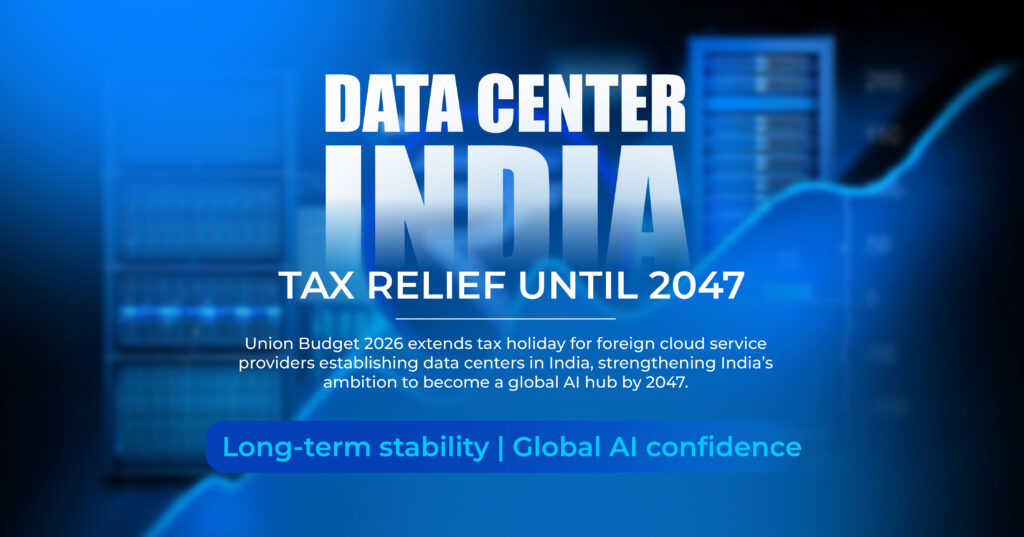 One of the most significant measures announced in this year’s budget is the tax holiday extended to foreign cloud service providers establishing data centers in India until 2047. By offering long-term certainty on taxation, the government is sending a strong signal to global cloud players about India’s readiness to host critical workloads.
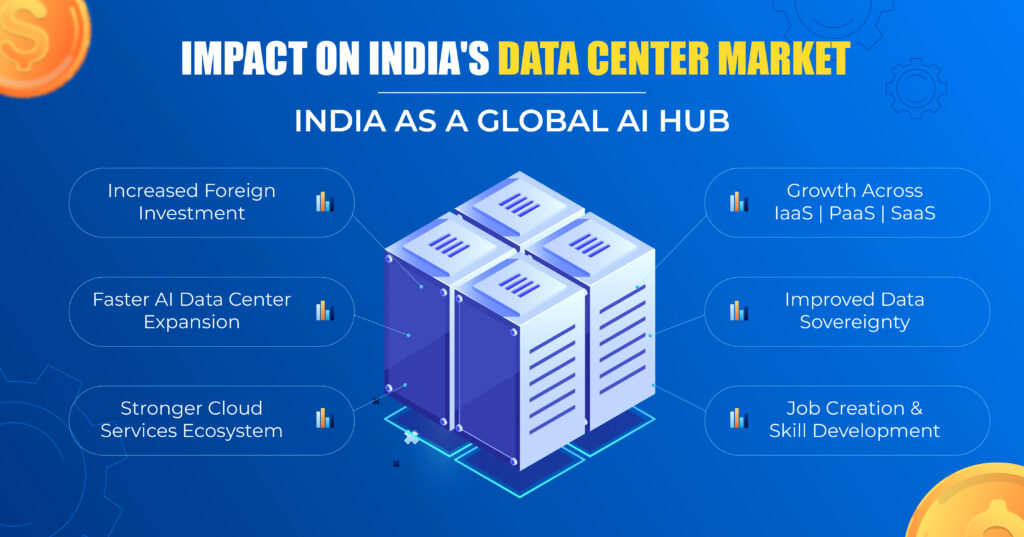
These tax concessions are contingent upon foreign cloud companies providing services to Indian customers through locally incorporated reseller entities. This approach simultaneously promotes data sovereignty and ensures that the economic benefits of cloud adoption such as jobs, taxation and skill development, remain in India. The policy is expected to attract substantial foreign investment into AI Data Centers, directly supporting India’s AI adoption roadmap.
15% Safe Harbour: Reducing Risk for Indian Operators
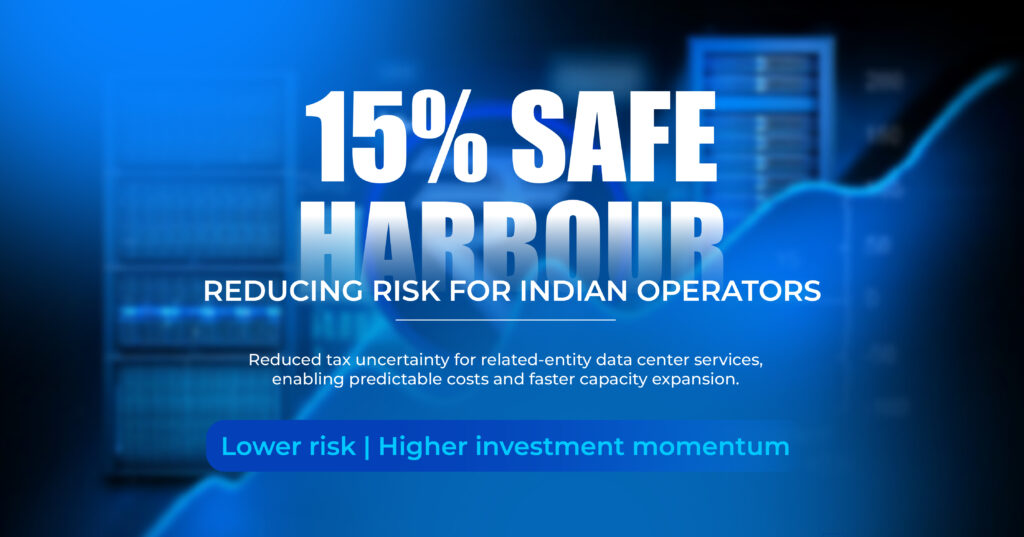
In addition to tax holidays for foreign investors, the budget introduces a 15% safe harbour on costs for data center services operated through related entities. This measure reduces uncertainty in taxation, providing Indian operators with a predictable financial environment. By mitigating risks, this safe harbour is likely to encourage operators to expand capacity, adopt advanced technologies, and offer competitive cloud services to both domestic and international clients.
The combination of tax concessions and safe harbour provisions strengthens India’s positioning as a global hub for AI and cloud infrastructure. By reducing operating costs and increasing financial predictability, the government is facilitating a fivefold increase in data center capacity by 2030 — a goal that aligns with India’s AI ambitions.
Implications for Cloud Services and Cloud Service Models
The budget’s measures have significant implications for the broader cloud services ecosystem. By incentivizing foreign cloud providers to establish operations locally, India can expand access to global-grade infrastructure for enterprises of all sizes. This fosters competition and innovation across different cloud service models, including Infrastructure as a Service (IaaS), Platform as a Service (PaaS), and Software as a Service (SaaS).
For businesses, this means faster deployment of AI workloads, lower latency, and enhanced data security. For startups and innovators, the policy lowers barriers to entry, providing access to scalable, reliable computing resources without requiring heavy upfront capital expenditure. Overall, the budget sets the stage for a vibrant cloud ecosystem that is both globally competitive and domestically empowering.
Aligning Infrastructure with Employment and Skill Development
The government has also highlighted the employment and skill development potential of the data center ecosystem. Hon’ble Prime Minister Narendra Modi remarked that the budget would give a “significant boost to employment generation,” particularly for youth engaged in high-tech operations, maintenance, and AI development. This policy focus ensures that India’s transition into a global AI hub is inclusive, with opportunities extending beyond urban centers to emerging tech corridors across the country.
By linking tax incentives with local employment and operational requirements, the Union Budget 2026 creates a framework where economic, technological, and social objectives reinforce each other. Data centers are no longer just physical spaces; they are engines of innovation, job creation, and global competitiveness.
Strategic Outlook: India as a Global AI Data Hub
Taken together, these policy measures signal India’s intent to become a global player in AI and cloud infrastructure. The tax concessions and safe harbour policies provide a stable foundation for foreign investment, while local employment and skill development initiatives ensure that growth is sustainable and inclusive.
As the country aims for a fivefold expansion of data center India capacity by 2030, the infrastructure created today will serve as the backbone for AI-driven industries of tomorrow. From advanced AI computation to real-time analytics and cloud-native applications, India is positioning itself to serve a global clientele, supporting both domestic innovation and international competitiveness.
NES DATA: Enabling the Vision
At the forefront of this transformation, organizations like NES DATA are playing a critical role in operationalizing this vision. NES DATA’s colocation services offer enterprises and cloud providers a reliable, scalable platform for hosting AI workloads, adhering to the highest standards of performance and compliance. By providing end-to-end infrastructure solutions across diverse cloud service models, it enables businesses to leverage India’s growing data center ecosystem while aligning with the government’s AI and cloud initiatives.
As India steps onto the global AI stage, NES DATA emerges as a strategic partner, bridging global standards with local excellence. In doing so, it helps build a future-ready AI data center ecosystem: robust, innovative, and globally competitive.
FAQs
1. What is Data Center India and why is it critical for AI growth?
Data Center India refers to the growing network of high-performance, secure, and scalable data centers across India. These facilities are critical for supporting AI workloads, cloud-based applications, and enterprise data storage. With India aiming to become a global AI hub, investing in reliable local data centers ensures low latency, data sovereignty, and readiness for advanced AI and cloud innovations.
2. How does the Union Budget 2026 benefit AI Data Centers in India?
The Union Budget 2026-27 introduces a tax holiday until 2047 for foreign cloud providers establishing AI data centers in India, along with a 15% safe harbour for domestic operators. These measures reduce operating costs, boost investment confidence, and encourage capacity expansion. The policy also ensures services for Indian customers via local reseller entities, promoting data sovereignty and sustainable growth.
3. What are the Union Budget incentives for cloud services in India?
The Union Budget provides strategic incentives for cloud services providers, including long-term tax concessions and safe harbour provisions. These policies encourage foreign and domestic cloud companies to invest in Indian data centers, supporting enterprise adoption of scalable cloud solutions and advanced AI workloads, while maintaining compliance with local regulations.
4. Which cloud service models are supported under India’s new data center policies?
India’s data center policy benefits all major cloud service models, including IaaS (Infrastructure as a Service), PaaS (Platform as a Service), and SaaS (Software as a Service). By promoting local hosting of cloud infrastructure, the policy reduces latency, ensures data security, and enables businesses to adopt AI-powered solutions efficiently and cost-effectively.
5. How can NES DATA help businesses leverage India’s growing AI Data Center ecosystem?
NES DATA offers enterprise-grade colocation services across India, enabling businesses to host AI workloads securely and reliably. NES DATA provides scalable, high-performance infrastructure that aligns with India’s vision to become a global hub for AI and cloud services, helping enterprises meet global standards while benefiting from local data center advantages.
Sources:
India’s AI ambitions by The Economic Times
PM’s remarks on Union Budget 2026
The Economic Times
Ministry of Electronics & IT