
Businesses today have access to more data than ever. But more data does not always lead to better decisions. The challenge is turning large amounts of information into useful insights.
These insights can help businesses improve operations, predict demand, and support growth.
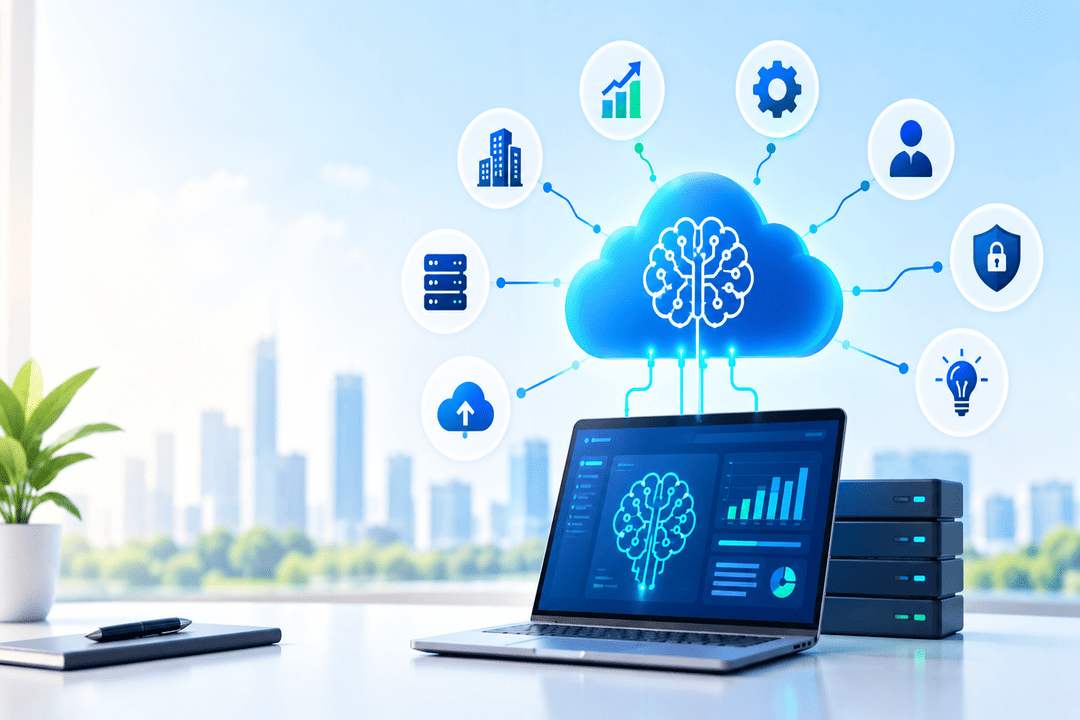
Cloud AI-ML services can help bridge this gap. By moving AI workloads to the cloud, businesses can access the computing power and tools needed to build and run AI and machine learning applications.
These services can support use cases such as demand forecasting, workflow automation, and customer personalization. With AI/ML Cloud Services from NES DATA, enterprises can also build cloud environments that support their computing, storage, and security needs.
This guide covers the key enterprise use cases of cloud AI-ML services, their benefits, and the steps businesses can follow to implement them.
What Are Cloud AI-ML Services?
Cloud AI-ML services are cloud-based tools, platforms, and infrastructure used to develop, train, deploy, and manage artificial intelligence and machine learning applications.
Instead of building dedicated infrastructure for every AI workload, businesses can use cloud resources for:
- Computing
- Storage
- Data processing
- Model development
- Model training
- Application deployment
A typical AI-ML project starts with data collection and preparation. The model is then developed and trained using this data.
After testing and validation, the model can be deployed. It can then be connected to business applications or workflows.
Performance should also be monitored after deployment. This helps businesses check whether the model continues to deliver the expected results.
This approach gives businesses access to the infrastructure and tools needed for AI-ML projects. It can also reduce the need to build and manage every part of the underlying infrastructure themselves.
Enterprise Use Cases of Cloud AI-ML Services
AI-ML can support many areas of an enterprise. The right use case depends on the business goal, available data, and operational needs.
1. Predictive Analytics
Machine learning can analyze past and current data to identify patterns and forecast possible outcomes.
Businesses can use predictive analytics for:
- Demand forecasting
- Predictive maintenance
- Sales projections
- Resource planning
These applications can help teams anticipate future needs and make more informed decisions.
2. Customer Experience and Personalization
AI-ML can help businesses understand customer preferences and behavior.
Recommendation engines, customer segmentation, and personalized interactions can make digital experiences more relevant.
Businesses can use these tools to support engagement across websites, applications, and other digital channels.
3. Intelligent Automation
AI-ML can automate repetitive tasks that involve large amounts of structured or unstructured data.
Common examples include:
- Document classification
- Data extraction
- Workflow routing
- Information processing
Automation can reduce manual work and help shorten processing times.
4. Fraud Detection and Risk Analysis
Machine learning can analyze transaction and business data to identify unusual patterns.
This can help businesses:
- Monitor transactions
- Assess risk
- Detect unusual activity
- Prioritize transactions for further review
AI-ML does not replace human review in every situation. Instead, it can help teams focus their attention on activity that may require further investigation.
5. Computer Vision and Natural Language Processing
AI-ML can also work with images, video, and language-based data.
Computer vision can support applications such as quality inspection and image analysis.
Natural language processing (NLP) can support:
- Document analysis
- Text classification
- Chatbots
- Virtual assistants
Benefits of Cloud AI-ML Services for Enterprises
AI-ML can provide useful business capabilities. Cloud infrastructure can make these workloads easier to deploy and scale.
Key benefits include:
Scalable resources: AI-ML workloads may need different levels of computing power at different stages. Cloud environments allow businesses to adjust resources as their needs change.
Faster deployment: Pre-built services and managed tools can reduce the infrastructure work needed to launch an AI-ML application.
Flexible cost models: Businesses can choose cloud resources based on their workload and usage instead of purchasing dedicated infrastructure upfront.
Integration with existing systems: Cloud platforms can connect AI-ML workloads with databases, data warehouses, applications, and other business systems.
Operational efficiency: Cloud-based AI-ML environments can support automation and data processing for a range of business applications.
Access to new technologies: Cloud providers continue to introduce new AI and ML tools. Businesses can evaluate these services based on their specific needs.
How to Implement Cloud AI-ML Services
A successful AI-ML project should start with a business need, not just the technology.
A structured approach can help businesses select the right solution and measure its results.
1. Define the Business Problem
Start by identifying a specific business problem where AI-ML could provide measurable value.
Define the expected outcome and success metrics before selecting a technology or model.
2. Assess Data Readiness
Check whether the data needed for the project is available and suitable for its intended use.
Review:
- Data quality
- Data volume
- Data access
- Data governance
- Data security
Good data preparation is an important part of building a useful AI-ML solution.
3. Choose the Right Cloud Environment
Evaluate the infrastructure needed for the workload.
Consider factors such as:
- Computing requirements
- Existing systems
- Security
- Compliance
- Integration
- Future growth
The selected environment should also fit into the organization’s wider technology setup.
4. Select the AI-ML Approach
The business use case should guide the technology choice.
Depending on the goal, businesses may use:
- Predictive models
- Classification
- Recommendation systems
- Natural language processing
- Computer vision
- Generative AI
5. Develop, Deploy, and Integrate
Prepare the data and develop the model. Train it and validate the results before deployment.
Once the model is ready, connect it to the applications, APIs, workflows, or systems that will use its output.
6. Monitor and Optimize
AI-ML management does not end after deployment.
Businesses should continue to monitor:
- Model accuracy
- Changes in data
- Resource usage
- Security
- Operating costs
Regular monitoring can help teams identify problems and make changes when needed.
Key Considerations When Choosing Cloud AI-ML Services
Before selecting a cloud AI-ML service, businesses should consider how well it fits their technical environment and business needs.
Security and privacy: Understand how business data is stored, processed, accessed, and protected.
Scalability: Check whether the environment can support future increases in data and workload.
Integration: Check compatibility with existing applications, databases, APIs, and data platforms.
Compliance: Consider industry regulations and internal data governance requirements.
Performance: Evaluate computing capacity, availability, processing needs, and expected workload performance.
Cost: Consider computing, storage, service usage, and ongoing management costs.
Support: Review the available technical support, monitoring, maintenance, and troubleshooting services.
Expertise: Assess whether internal teams have the cloud, data, AI-ML, security, and integration skills needed to manage the solution.
Why Choose NES DATA for Cloud AI-ML Services?
AI-ML workloads need infrastructure that can support their computing, storage, security, and operational needs.
NES DATA provides cloud infrastructure solutions for enterprise workloads. These solutions can help organizations build cloud environments that align with their technology and business requirements.
Talk to NES DATA about building the right cloud environment for your AI-ML workloads.
FAQs
What are cloud AI-ML services?
Cloud AI-ML services provide cloud-based infrastructure, tools, and platforms for developing, training, deploying, and managing AI and machine learning workloads.
What are common enterprise AI-ML use cases?
Common applications include predictive analytics, customer personalization, intelligent automation, fraud detection, computer vision, and natural language processing.
What are the benefits of cloud AI-ML services?
They can provide scalable resources, flexible infrastructure, faster deployment, integration options, and access to new AI and ML technologies.
How can businesses implement AI-ML in the cloud?
Businesses can start by defining a use case and assessing their data. They can then select an appropriate cloud environment and AI-ML approach before developing, deploying, and monitoring the solution.
What should businesses consider when choosing cloud AI-ML services?
Key factors include security, scalability, integration, compliance, performance, cost, technical support, and the skills needed to manage the solution.